


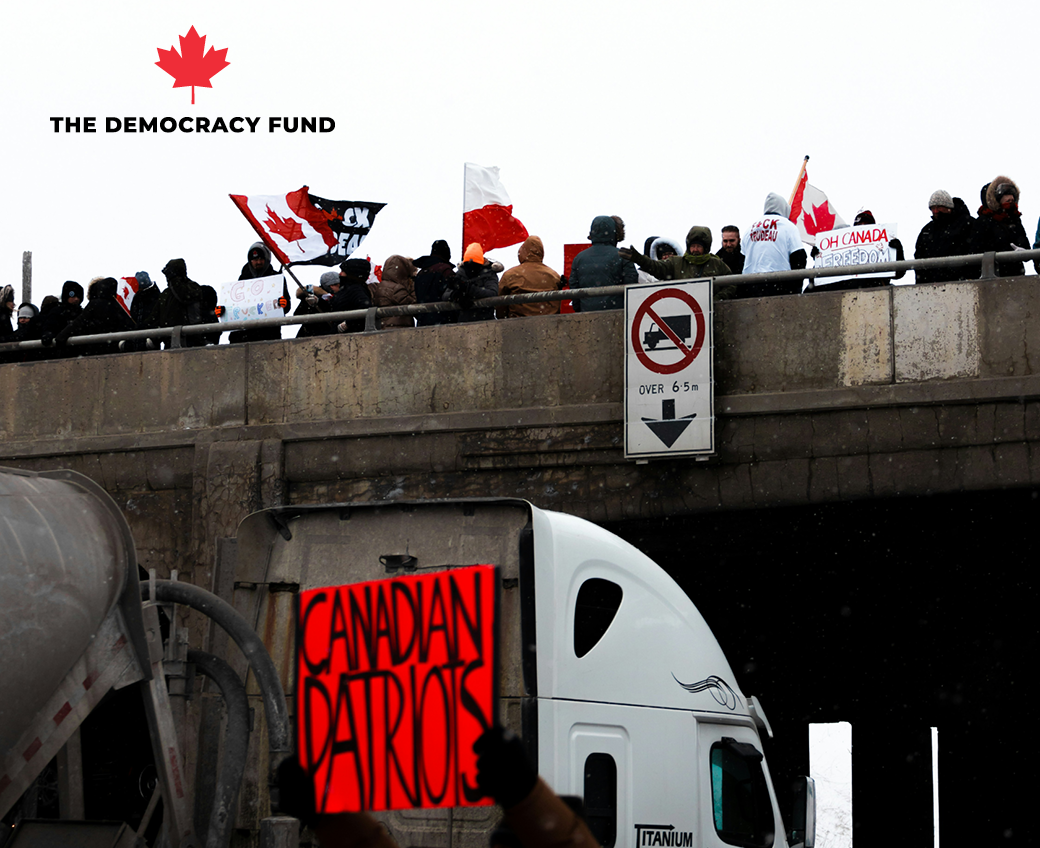
The government seeks to overturn a unanimous Federal Court of Appeal ruling that upheld the Federal Court’s finding that its invocation of a public order emergency against the Freedom Convoy was unreasonable and unconstitutional.
OTTAWA: On October 22, the Supreme Court of Canada announced that it will hear the federal government's appeal of the Federal Court of Appeal's decision that the 2022 invocation of the Emergencies Act was unlawful. The Democracy Fund (TDF), which argued before the Public Order Emergency Commission that the government lacked the legal grounds to declare a public order emergency, maintains that both lower courts decided the matter correctly.
On February 14, 2022, the federal Cabinet declared a public order emergency under s. 17 of the Emergencies Act in response to the Freedom Convoy protests in Ottawa and the blockades at several border crossings. The regulations that followed prohibited certain public assemblies and authorized financial institutions to freeze the accounts of people connected to the protests without a court order. The declaration was revoked on February 23, 2022.
On January 23, 2024, Justice Richard Mosley of the Federal Court ruled that the decision to invoke the Act was unreasonable and that the emergency measures infringed s. 2(b) and s. 8 of the Charter, which protect freedom of expression and the right to be secure against unreasonable search and seizure. On January 16, 2026, a unanimous panel of the Federal Court of Appeal dismissed the government's appeal. The Court held that the government had not shown reasonable grounds to believe that a threat to the security of Canada or a national emergency existed, or that existing laws were unable to resolve the situation. The Attorney General of Canada has argued that the lower courts applied the wrong principles on judicial review and second-guessed Cabinet with the benefit of hindsight.
The Supreme Court does not give reasons when it grants leave to appeal; a grant means only that the Court considers the questions to be of public importance, not that it has formed a view on the merits. A hearing date has not yet been set.
Parliament passed the Emergencies Act in 1988 to replace the War Measures Act, and it drafted the new law narrowly on purpose. A public order emergency requires threats to the security of Canada, as defined in s. 2 of the CSIS Act, serious enough that they constitute a national emergency that cannot be dealt with under any other law of Canada. Peaceful assembly under s.2(c) of the Charter is disruptive by nature, and disruption alone does not constitute a national emergency. The statutory thresholds are written to protect disruptive but peaceful protests from government nullification; without that protection, governments can and will arbitrarily invoke the Emergencies Act to suspend legal rights.
TDF had standing at the Public Order Emergency Commission in the fall of 2022, where its lawyers argued that the thresholds had not been met. TDF lawyers also attended the Ottawa and Windsor protests as legal observers. Afterwards, it defended many Canadians criminally charged for their peaceful participation in the protests.
TDF Executive Director, Mark Joseph, said: "Two courts have now examined the same record and reached the same conclusion: there was no national emergency as defined by relevant statutes. The government's central argument - that judges should defer to Cabinet's belief that an emergency exists - would reduce the Act's safeguards to a formality. The "reasonable grounds" upon which the invocation is based must refer to objective factors giving rise to the subjective belief of Cabinet ministers; otherwise there are no restrictions on invoking an emergency under the Act. We're hopeful that the Supreme Court will take the opportunity to rule that emergency powers are bounded by law."
TDF will follow the appeal closely and report on the hearing once it is scheduled.
About The Democracy Fund:
Founded in 2021, The Democracy Fund (TDF) is a Canadian charity dedicated to defending constitutional rights, promoting free speech and religious freedom, and opposing religious discrimination. TDF advances these principles through litigation, public education, educational initiatives, and access-to-justice programs for Canadians whose civil liberties have been infringed.
